Why Open Ground Feels Different Beside the Sea
Why open ground feels different beside the sea: use field edges and fixed landmarks to read the playing area and understand how its setting shapes the view.
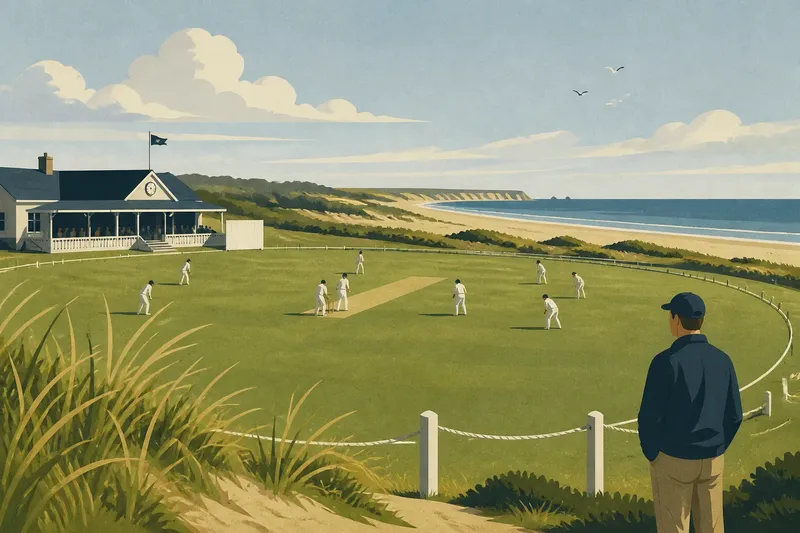
The common mistake at a coastal ground is to use the distant horizon as the field’s edge. That can make a boundary hard to read and leave the playing area feeling unframed. Why open ground feels different beside the sea is often a matter of contrast: sky, water, and dunes offer little visual separation from the field.
Instead of judging the ground by its view, look for the details that define its playing surface and setting. Boundary ropes, posts, changes in grass, a pavilion, and a line of dunes each tell you something different. Together, they can make an open landscape easier to understand without turning the sea view into a seating question.
Find the field edges
At an inland ground, buildings, trees, or fences may frame the action. A coastal field can open onto sky, water, dunes, or flat land, so the landscape may seem to continue beyond the playing area. The horizon is a distant feature, not a reliable marker of where play ends.
Look for the ground’s own boundary cues: a rope, painted line, post, low barrier, or change in the grass. If one edge is difficult to distinguish, use a fixed feature near that end as a reference, then compare it with the visible field markers.
Say you arrive at an open cricket ground where the sea lies beyond one boundary and a pavilion stands behind the opposite end. First, identify the pavilion and the boundary rope. Then note which end is nearest the water and use those two features to keep track as play changes direction. The result is a clearer sense of the field’s layout without treating the horizon as part of the playing area.
Use fixed references
Choose a feature that stays put and has a recognizable shape: a scoreboard, stand roof, clubhouse gable, flagpole, or gap between dunes. It need not be near the middle of the ground. Its value is that you can identify it quickly and use it as a steady point of reference.
Give the ends or sides simple names, such as “pavilion end” and “dune end,” or “stand side” and “promenade side.” These labels do not need to match a map. They make it easier to understand directions from stewards, spectators, or a companion.
Keep fixed features separate from temporary cues. A crowd may help outline one side of a local playing area, but spectators can move or leave. Use people as a clue, not as proof of the boundary.
Read light and contrast
Coastal light can change how clearly players and field markings stand out. A dark uniform may be easy to distinguish against pale water, while a light one may blend into bright sky or sand. Clouds can also change the contrast between the field and its background.
Before play, check whether the markings and players are distinct against the surroundings. If a boundary disappears against water or sky, look for another cue, such as a post or rope. If the players blend into the background, use a nearby structure or darker land feature to help track their movement.
Do not assume one landmark solves every viewing problem. A scoreboard can help you orient yourself while offering little help in distinguishing players from the background. Use the scoreboard to name your location and a separate visual cue to read the action.
What can you use as a reference?
What if no boundary line is visible?
Look for posts, a rope, a mown edge, or a clear change in surface. If those cues still leave the limit uncertain, ask a steward or someone familiar with the ground rather than guessing from the coastline.
How should you name the ends?
Use two stable landmarks, such as “pavilion end” and “dune end,” and keep those names consistent. Avoid relying on the sun or the direction of the sea, which may not tell you which part of the field someone means.
What if players are hard to see?
Check what lies directly behind the area where play is happening. A stand, wall, or darker band of vegetation may make players easier to distinguish than open water or bright sand.
Should spectators count as a field edge?
They can help you see where attention is focused, but they do not define the playing limit. Use a visible marking or ask an official if the boundary itself is unclear.
Let the ground explain itself
Coastal grounds are not always exposed directly to the water. Some sit behind dunes, beside a promenade, or between a village and open shore. A low rise, scrub, or building may screen one side while leaving the other open to the landscape.
Notice which parts of the field have a clear backdrop and which appear to merge into the surroundings. A pavilion or line of vegetation can help define an edge; an open stretch may need closer attention to posts or markings. The ground’s shape, not just its proximity to the sea, determines which cues are easiest to use.
- Check for a rope or painted line; if it is clear, use it to read the boundary, and if it is faint, look for posts or ask a steward.
- Check whether posts mark the ends; if they are visible, use them to anchor the field, and if they are hidden, identify another fixed feature.
- Check for a change in grass or surface; if it follows the playing limit, use it as a secondary cue, and if it does not, do not treat it as the boundary.
- Check whether a pavilion or stand is visible; if so, use it to name an end or side, and if not, choose a different stable landmark.
- Check whether the sea or sky washes out a field marking; if it does, look for a post, rope, or darker background, and if it does not, keep using the marking.
- Check whether spectators are gathered along an edge; if they are, treat them only as a temporary clue, and if the boundary matters, confirm it with a marking or steward.
Skip unnecessary fuss
There is little value in trying to memorize a compass bearing or identify every distant landmark before a local match. A pair of simple names and one clear boundary cue are usually enough to make the layout understandable. If a particular edge remains unclear, asking someone familiar with the ground is more useful than trying to infer it from the coast.
For a quick orientation, identify one fixed feature near each end and one visible playing limit. Why open ground feels different beside the sea becomes easier to understand when you separate the landscape from the field: the coast may have no obvious frame, but the ground still has its own markers.
Once you know which cues belong to the playing area, you can tell when a landmark is merely part of the scenery and when a marking needs confirmation. That distinction is useful at any open local ground, especially when weather or light changes the way its edges appear.