Promenade or Back Street: Choosing an Arrival Route
Choose a promenade or back-street arrival route to match your pace, avoid needless detours, and reach a coastal match with time to settle in.
The most common mistake when choosing a promenade or back-street arrival route is assuming the prettier way is automatically the better way. That can cost you a calm arrival: you may reach the ground feeling hurried after stopping for views, weaving through walkers, or discovering that the promenade does not lead to the entrance you expected.
Choose by the kind of arrival you want. A promenade usually favors a gradual, open approach; an inland street often favors a direct line and fewer distractions. Neither is always faster or more comfortable. The useful question is what you want the walk to do before the match: give you room to ease into the day, or get you to the gate with minimal fuss.
Start with your arrival
Think of the route as part of the matchday, not just a connection between the station, car park, or bus stop and the ground. A scenic approach can help a visit feel unhurried, especially if you have time to pause and watch the shoreline. A direct approach can be the better fit when you are carrying a bag, meeting someone at a set point, or trying to arrive without adding another decision.
Separate three things that often get bundled together: distance, walking conditions, and pace. A route that looks shorter on a map may involve a busy crossing or a narrow sidewalk. A longer route may feel easier if it is open and straightforward. Look at the route on a map, then check current access signs or local visitor information for temporary closures and event arrangements.
What each route offers
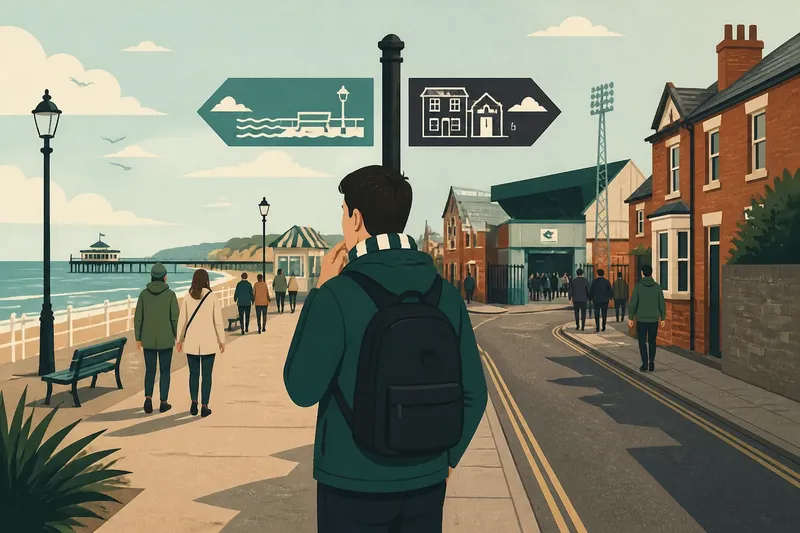
The promenade is usually an easy route to recognize: it follows the seafront, often past benches, kiosks, beach access points, or public spaces. Its appeal is not only the view. It can provide a clear landmark trail, giving a first-time visitor a sense of where the ground sits in relation to the shore.
That openness can also mean shared space. Walkers may pause, cyclists may pass, and people heading to the beach may move in groups. If you want to stroll, that activity can be part of the pleasure. If you want to keep a steady pace, the same conditions can make the route feel stop-and-start.
Back streets tend to trade scenery for a more purposeful line. They may pass shops, residential blocks, or side roads that lead toward the venue’s inland entrance. Their advantage is often practical: fewer reasons to stop, and sometimes a clearer path from a transit stop or parking area. Their drawback is that turns and crossings can be less intuitive, particularly if local signs are sparse.
Do not assume “inland” means quiet or “promenade” means accessible. Matchday traffic, construction, beach access rules, and crowd direction can change the feel of either route. Where access depends on venue guidance, posted signs, or local rules, follow those rather than relying on a map line.
Choose your walking pace
For a relaxed arrival, choose the promenade when you have enough margin to pause without watching the clock. You can take in the shoreline, orient yourself, and approach the ground gradually. Decide in advance where you will leave the promenade for the entrance; otherwise, a pleasant walk can become an improvised search at the last turn.
For a brisk arrival, favor the most legible direct route, which may be a back street. Check that it connects to the gate you need, not merely the general address. If you are meeting friends, agree on a specific landmark such as a named transit stop, a public building, or the venue’s signed entrance. “Near the ground” is not a useful meeting point when several streets lead there.
Say you are visiting a small coastal football ground for an afternoon match and have time before the gates open. You could follow the promenade to a recognizable public pier, then turn inland at the signed street leading to the venue; the expected result is a relaxed walk with a clear landmark for the final turn. If the same visitor is arriving close to kickoff, they could take the mapped back-street route straight to the signed gate instead, avoiding a scenic detour and preserving attention for finding the entrance.
Check the route details
Before setting out, check the practical features that can change your choice:
- Gate location: Confirm which entrance serves your ticket or event area, then trace the route to that gate.
- Transit connection: See whether the station or bus stop sits nearer the promenade or the inland streets.
- Crossings: Note major roads, traffic signals, and places where a direct-looking route requires a detour.
- Shared paths: Look for signs that distinguish walking areas from cycle routes or beach access.
- Meeting point: Pick a recognizable place that does not block a doorway or narrow path.
- Return route: Check whether the same path remains convenient after the match, when crowds may move in the opposite direction.
Use a map for orientation, not as a promise that every path is open or pleasant. A map can show the line; local signs and your own observation tell you whether that line is usable on the day. Keep a second route in mind if the first approach is crowded or closed.
Which route fits your visit?
Is the promenade always slower?
No. A seafront path can be direct if the ground lies along it and the entrance is easy to identify. It may feel slower when visitors stop, share a narrow section, or have to turn inland near the venue.
When is a back street the better choice?
Choose it when you want a direct arrival, have little time to spare, or need to reach a specific inland gate. Check crossings and turns first so the apparent shortcut does not become a confusing detour.
Can you combine both routes?
Yes: use the promenade for the scenic part, then turn inland at a clear landmark. This works best when you have already identified the connecting street and know which entrance you are aiming for.
What if the matchday route is crowded?
Follow venue or local direction signs and avoid forcing your way through a dense group. If the promenade is congested, use a permitted parallel street; if an inland street is busy, pause somewhere clear of the flow before checking your map.
Keep the choice simple
There is little value in comparing every possible turn or searching for a perfect route. Pick a primary approach, identify the gate and one landmark, and keep a sensible alternative. That is enough planning for most visits without turning the walk into a navigation exercise.
For a coastal match, the best arrival route is the one that suits your time and the mood you want before play begins. Use the promenade when the walk itself is part of the outing; use the back street when a clear, direct arrival matters more. Check the main search phrase—promenade or back-street arrival route—against the actual entrance and conditions, then leave room to adjust once you are there.